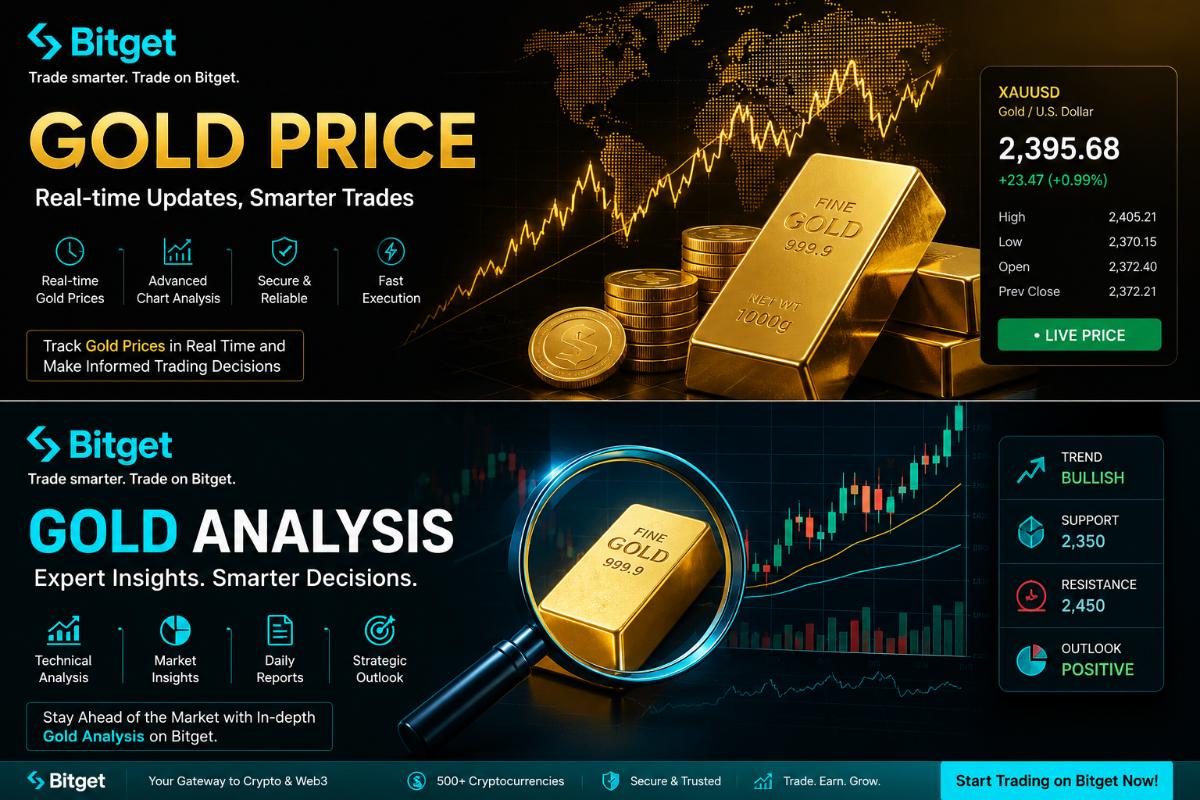
Investors and analysts alike keep a close eye on the live gold price chart for a single day (1D). This real – time data provides a snapshot of how the gold market behaves within a short time frame, offering valuable insights into price movements, trends, and potential trading opportunities.Bitget provides a live gold price chart (1D) to show intraday movement, alongside key session stats (open/high/low/close and last update time) for quick, source-backed price context.
Components of the 1D Live Gold Price Chart
The 1D live gold price chart is composed of several key elements. The x – axis represents time, usually divided into minutes or hours, showing the progression of the trading day. The y – axis indicates the price of gold, which can be in various currencies such as the US dollar, euro, or yen. Each data point on the chart represents the price of gold at a specific moment in time. Candlestick patterns are commonly used in these charts. A candlestick shows the opening, closing, high, and low prices for a given time interval. A green or white candlestick indicates that the closing price is higher than the opening price, suggesting bullish sentiment, while a red or black candlestick means the closing price is lower, indicating bearish sentiment.
Factors Influencing 1D Gold Price Movements
Multiple factors can impact the 1 – day gold price. Economic data releases play a significant role. For example, if the latest employment figures in the United States are better than expected, it may strengthen the US dollar. Since gold is often inversely related to the dollar, this could lead to a decline in the gold price. Geopolitical events also have a profound effect. Tensions between countries, such as trade disputes or military conflicts, can increase the demand for gold as a safe – haven asset, driving up its price. Central bank policies, like changes in interest rates or quantitative easing measures, can also sway the 1 – day gold price. A decrease in interest rates makes holding non – interest – bearing gold more attractive, potentially pushing up its price.
Analyzing the 1D Gold Price Chart for Trading
Traders use the 1D gold price chart to make informed decisions. Technical analysis is a popular approach. By identifying support and resistance levels on the chart, traders can determine potential entry and exit points. For instance, if the gold price approaches a well – established resistance level and shows signs of reversing, a trader might consider selling. Moving averages are another important tool. Short – term moving averages, such as the 10 – minute or 30 – minute moving average, can help traders spot trends and momentum. If the price crosses above a moving average, it could be a signal to buy, while a cross below might indicate a sell signal.
Limitations of the 1D Live Gold Price Chart
While the 1D live gold price chart is useful, it has its limitations. Short – term price movements can be highly volatile and subject to market noise. A sudden spike or dip in the price may not necessarily reflect a long – term trend. Additionally, the chart only provides a snapshot of a single day, so it may not capture broader market trends or fundamental changes in the gold market. Traders should use the 1D chart in conjunction with other longer – term charts and fundamental analysis to make more comprehensive trading decisions.
About the Author